

Every reasonable conversation about Guyana’s future eventually comes back to education, and most of those conversations end up in the same place. We need to invest more, train more teachers, build more schools, raise pass rates, and improve outcomes at the Caribbean Examinations Council. These things are all true. They are also insufficient, and the reason they are insufficient is that we have been measuring educational success by the wrong yardstick for at least a generation.
The yardstick we use is essentially the colonial one. Children sit examinations. The examinations rank them. Higher ranks lead to better secondary schools, then to better tertiary opportunities, then to professional credentials. The credentials are valued primarily because they qualify the holder for employment in a defined set of professions that the colonial state once needed and the post-independence state has continued to need. Doctor, lawyer, accountant, civil servant, teacher, engineer in narrowly defined disciplines. The graduate who reaches the top of this system is then absorbed into one of these tracks or, increasingly, takes the credentials and emigrates.
The problem is that this educational system was built to produce employees, not founders. It was built to fill positions in an established economic structure, not to create new structures. It rewards memorisation over problem-identification, deference to authority over independent judgment, and risk-aversion over experimentation. The students who go furthest within it are the students who play the existing game best. The students who would build new industries, new firms, and new productive capabilities are, with rare exceptions, the same students the system underrates or loses.
Read against the literature on small open economies, this matters more than most countries’ educational debates do. The economists David de la Croix and Frédéric Docquier have shown that small island developing states lose roughly fifty percent of their high-skilled labour force to emigration, with the figure exceeding seventy-five percent in the worst cases. Approximately thirty-nine percent of all Guyanese citizens already live abroad, and roughly half of all Guyanese with tertiary education are in the United States alone. The country trains its best minds at significant public expense and then loses them to economies whose markets are deep enough to reward what those minds can do.
The educational reform agenda this implies is different from the one usually proposed. It is not primarily about quantity of provision, although that matters. It is about reorientation. Curricula at the secondary level should embed problem-identification, design thinking, and entrepreneurship from the early years, not as electives but as core competencies. Mathematics and science should be taught with explicit application to the problems Guyana’s economy actually faces, from coastal resilience to agricultural processing to renewable energy. Intellectual property literacy should be taught from the age of fifteen, so students understand that ideas have value and can be protected if the system is used properly. Tertiary programmes should be deliberately oriented toward globally tradeable services and globally relevant problems, not toward filling domestic vacancies that may not exist in five years.
The University of Guyana, properly resourced and strategically positioned, could anchor much of this. It is currently underfunded relative to its potential, and its research budget is a fraction of what a country with Guyana’s resources should be deploying. A serious public investment in university research, particularly in fields tied to the country’s productive ambitions and climate vulnerabilities, would do more for the long-term economy than another decade of conventional capital projects.
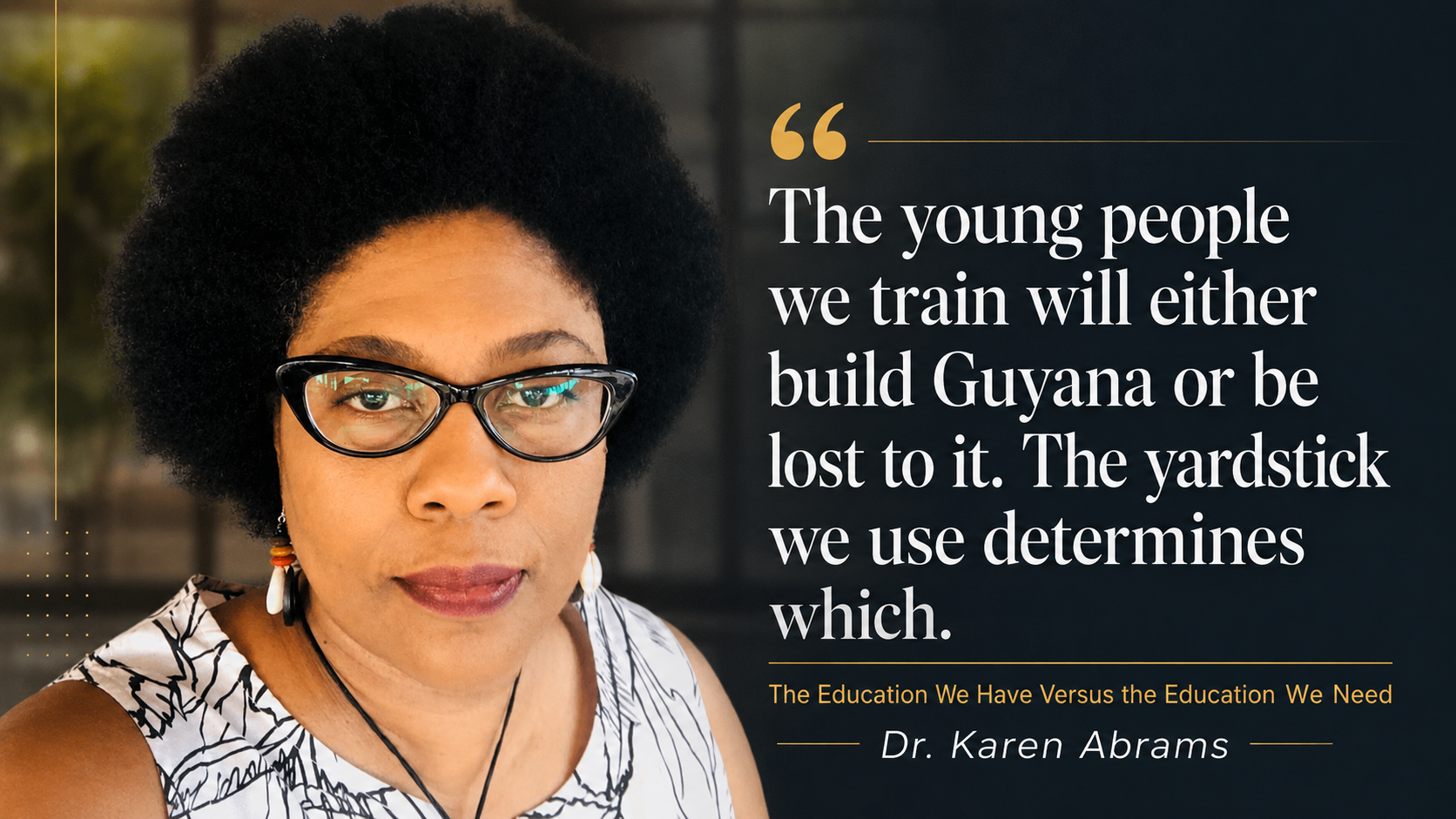
Education in this country is a strategic asset that has been managed for compliance rather than competitiveness. The young people we train will either build Guyana or be lost to it. The yardstick we use determines which.