



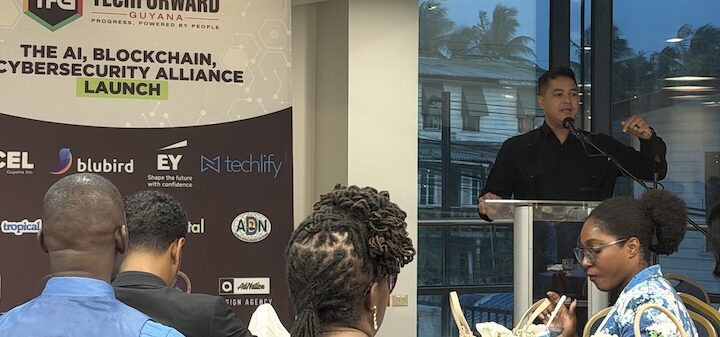
At the launch reception of the AI, Blockchain and Cybersecurity Alliance at the World Trade Centre Georgetown on June 18, Private Sector Commission Chairman Captain Gerry Gouveia delivered what may have been one of the most important messages for Guyana’s future.
While many discussions about technology in Guyana tend to focus on apps, gadgets, and the latest buzzwords, Gouveia correctly identified a much deeper issue. Technology is no longer a separate conversation from development. The technology conversation and the future of Guyana are now the same conversation.
As Guyana races ahead with double-digit economic growth, we often speak about oil, roads, hotels, housing, agriculture, tourism and manufacturing. What we discuss less frequently is the fact that every one of those sectors will increasingly be defined by technology. A country cannot aspire to become a modern economy while treating technology as an afterthought.
Gouveia challenged the audience to move beyond superficial understandings of emerging technologies. His observation that many people think AI begins and ends with ChatGPT, or that blockchain begins and ends with Bitcoin, was both humorous and accurate. The world is moving rapidly toward the adoption of artificial intelligence, automation, tokenization, robotics and advanced digital systems. The question is whether Guyanese businesses are moving at the same speed.
Perhaps the most important admission of the evening came when he stated that many private sector companies are actually slower than government in adopting digital technology. That should concern every business leader in Guyana.
For years, governments around the world have been criticized for being slow, bureaucratic and resistant to innovation. Yet in Guyana, government agencies are increasingly rolling out online appointments, digital services and citizen-facing applications while many businesses still require customers to call, visit in person, or navigate outdated manual processes. If that observation is correct, then the private sector has work to do.
Gouveia also made a compelling point about manpower. Guyana’s challenge is not simply a shortage of capital. It is a shortage of people. The country’s rapid expansion across oil and gas, agriculture, logistics, manufacturing, tourism and services is stretching the available labour force. His argument that technology must become a force multiplier deserves serious attention.
One of the most practical examples he cited involved agriculture. Around the world, autonomous tractors, AI-guided equipment and precision agriculture systems are already allowing fewer workers to produce more food. These are not futuristic concepts. They are commercially available technologies being deployed today. In a country where labour shortages are becoming increasingly common, the ability to multiply productivity through technology could prove transformative.
Where I believe the discussion must now go further is in the area of human capital. Technology alone is not enough. Guyana needs thousands of citizens who understand technology. We need software developers, cybersecurity professionals, AI specialists, data analysts, robotics engineers, product managers and technology entrepreneurs. More importantly, we need ordinary business owners who understand how technology can improve operations, reduce costs and create competitive advantage.
The real risk facing Guyana is not that technology will replace us. The real risk is that other countries and companies will use technology while we continue to rely on traditional approaches. As Gouveia noted, businesses that fail to embrace AI and digital transformation will increasingly find themselves competing against organizations that do.
His central message was simple but important: technology is not a sector. It is the infrastructure upon which every sector will increasingly depend.
For a country experiencing one of the fastest economic expansions in the world, that is a message worth hearing.
The challenge now is ensuring that the conversation does not end at conferences and launch receptions. The real test will be whether Guyanese businesses, educators, policymakers and citizens act on it.
Gouveia’s strongest point was not AI or blockchain specifically. It was his recognition that Guyana’s biggest constraint may soon be manpower, and that technology is the only realistic way to scale productivity fast enough to keep up with the country’s growth. That is a far more important insight than the usual “AI is the future” speech.