

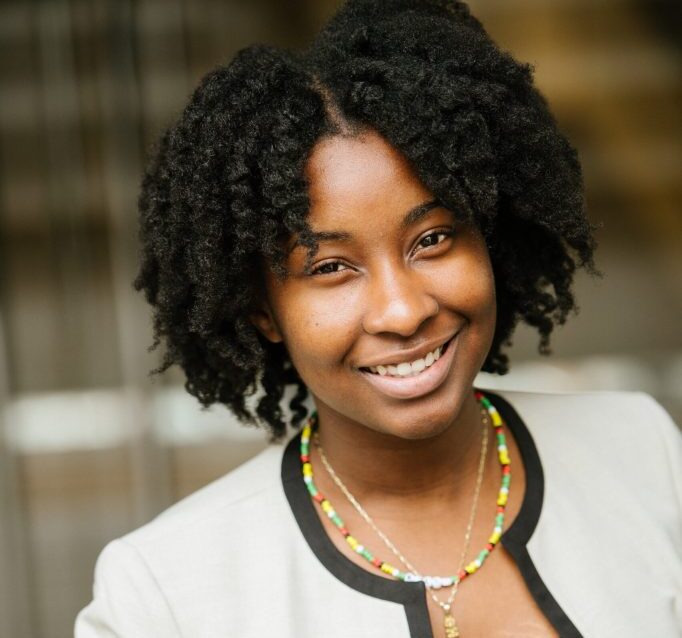
From a primary school in Vryheid’s Lust to Harvard, Stanford and a meeting with King Charles III, the young Guyanese scholar has built a record of service that deserves attention beyond the royal photograph.
It is not every day that a young woman from Vryheid’s Lust, East Coast Demerara, meets the King of England. For Kelly Anetta Hyles, that extraordinary moment arrived on October 14, 2026, when she met King Charles III at St James’s Palace in London. She had been selected as one of 100 young leaders recognised by the Queen Elizabeth II Commonwealth Trust for their contributions to communities across the Commonwealth. The award commemorates what would have been the late Queen Elizabeth II’s 100th birthday.
It would be easy to tell this story through the familiar photographs of a successful Guyanese young woman standing among royalty. After all, Hyles had already attracted national attention when she gained admission to all eight Ivy League universities in the United States, eventually choosing Harvard. She graduated with a degree in Human Developmental and Regenerative Biology and subsequently pursued medical and business studies at Stanford University. These are impressive achievements by any measure. But the more interesting story is what Hyles has been doing with the opportunities her education has provided.
In 2017, while still a Harvard student, she founded Gears for Success, a nonprofit organisation dedicated to improving educational opportunities for children in underserved Guyanese communities. The inspiration came partly from her experience mentoring students through the Harvard Ed Portal, where she observed the resources and support available to young learners. She understood that many children back home were equally capable but had considerably fewer opportunities.
She began with a school she knew well: Vryheid’s Lust Primary, where she had once been a student. Rather than arrive with a ready-made solution, Hyles consulted teachers and administrators to understand what the school needed. By August 2018, Gears for Success had helped establish a mathematics room and revive the school’s reading room, contributing more than 500 books. The organisation subsequently expanded into science summer camps and STEM education, including a weeklong camp for approximately 100 children. These were practical projects with identifiable beneficiaries, supported by donors and people willing to contribute their time and resources.
Her commitment to Guyana has also extended into healthcare. After graduating from Harvard in 2020, Hyles received the university’s Richardson Postgraduate Public Service Fellowship, which allowed her to return home and work with the 5G Dialysis Centre and the Ministry of Health. Her assignment focused on improving access to dialysis services, particularly for patients in underserved regions where specialised medical treatment can be difficult and expensive to obtain.
In a May 2026 interview with Kaieteur News, Hyles said that work contributed to the development and implementation of a recurring dialysis subsidy programme for vulnerable patients. She was especially proud that the assistance was designed to continue beyond her own involvement. There is an important insight in that experience. An individual can provide help for a day, a month or a year. Building a programme that continues helping people after its founder has moved on requires a different level of planning.
That is also the challenge facing Gears for Success as it approaches its tenth year. Hyles has discussed plans for a national STEM event, Gears Innovation Week, intended to bring together students from across Guyana. It is an interesting ambition, particularly for children living in communities where exposure to scientific careers, technology and specialised learning opportunities remains limited.
The next stage will require attention to the questions that determine whether a promising nonprofit can grow and endure. How many students and schools can it reach consistently? What partnerships and funding will sustain its programmes? How will the organisation measure whether its activities improve children’s educational opportunities and learning outcomes? These are reasonable questions for any educational nonprofit seeking to expand, and the Commonwealth recognition may help Hyles attract the partnerships needed to answer them.
The award itself offers opportunities for mentorship, networking, organisational development and potential funding. For a young founder trying to build an institution while pursuing a demanding career in medicine, access to experienced partners could prove valuable. But those opportunities are useful only when they translate into stronger programmes and better outcomes for the communities the organisation was created to serve.
There is a broader lesson here for the Guyanese diaspora. Hyles did not wait for a government invitation, a major grant or international recognition before beginning her work. She saw a difference between the educational resources available to children in the United States and those available to children at her former primary school. She spoke with the teachers, identified practical needs, sought support and started working. Recognition followed years later.
Guyana has many talented young people studying, working and building careers overseas. Some will eventually return home, while others will establish their lives abroad. Hyles’ experience demonstrates that contributing to national development does not necessarily require relocating permanently. It can begin with one school, one community and a commitment to solve a problem that someone knows exists.
On October 29, King Charles III is scheduled to arrive in Guyana for a two-day state visit, marking 60 years of diplomatic relations between Guyana and the United Kingdom. There will be ceremonies, official photographs and considerable attention surrounding the visit. By October 30, the King is expected to have completed his engagements and moved on.
But the reading room at Vryheid’s Lust Primary, the mathematics resources, the students introduced to science and the healthcare work Hyles helped advance tell another story. These efforts began long before the royal meeting and have value independent of it.
Kelly Hyles deserves recognition for her academic success and her Commonwealth award. She deserves even greater recognition for deciding, at a relatively young age, that the opportunities she received could become opportunities for other Guyanese children.
The photograph with the King is a memorable moment. The work that brought her there is what deserves to be remembered.