



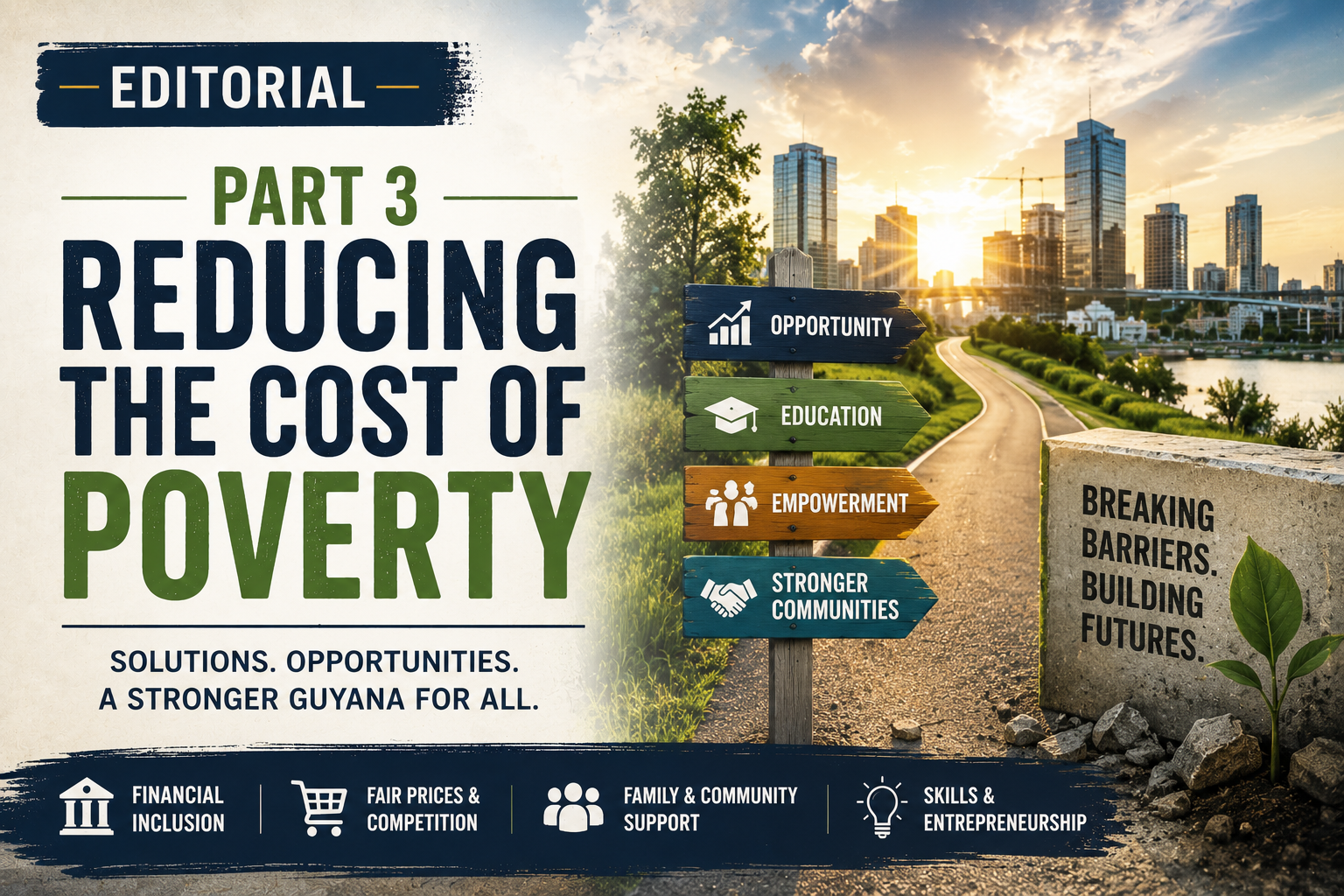
If poverty creates barriers, then public policy should focus on removing them.
Fortunately, there is no shortage of examples from around the world demonstrating what works.
Reducing the poverty premium requires more than economic growth. It requires investments in families, communities, and opportunity.
Greater financial inclusion can help households build savings and reduce dependence on costly alternatives. Mobile banking, community credit programmes, and accessible savings products have helped millions of low-income families improve their financial stability.
Competition matters as well. More competition in sectors that touch daily life, including food distribution, transportation, consumer services, and building materials, can lower prices and expand consumer choice.
Family counselling and support services should be readily available through health centres and community facilities across the country. Financial stress, domestic conflict, substance abuse, and mental health challenges often reinforce poverty across generations. Early intervention can help families stabilize before problems become crises.
Childcare assistance deserves serious consideration. In several countries, childcare vouchers and subsidized childcare programmes have enabled single parents to return to work, pursue training, complete their education, and improve their earning potential. Safe, supervised environments for children support parents while reducing children’s exposure to neglect, exploitation, and abuse.
Entrepreneurship support should move beyond simply providing loans or grants. Successful programmes increasingly pair financing with training in bookkeeping, marketing, cash flow management, customer service, and business planning. Access to capital matters, but access to knowledge often determines whether a business survives beyond its first few years.
As Guyana’s Development Bank takes shape, special effort should be made to ensure that lower-income families understand the opportunities available and possess the skills necessary to use them successfully.
There is also wisdom in revisiting the cooperative movement. In many villages and neighbouring communities, multiple families often enter identical businesses, competing for a limited customer base and reducing everyone’s earnings. Properly structured modern cooperatives can allow families to pool resources, purchase supplies at lower cost, share equipment, access larger markets, and negotiate better prices.
Poverty is rarely the result of a single disadvantage. It is usually the accumulation of many disadvantages acting together. The most successful anti-poverty strategies recognize this reality. They strengthen families, expand opportunities, build skills, improve access to services, and create pathways for communities to grow together rather than struggle alone.
Guyana’s oil wealth gives us a unique opportunity. We can choose to build an economy where prosperity accumulates at the top while barriers remain in place for everyone else. Or we can choose to systematically reduce those barriers and expand opportunity.
The true measure of our success will not be the number of barrels we produce or the height of our buildings.
It will be whether the next generation faces fewer obstacles than the one before it.
That is the promise of development.
And it is a promise worth pursuing.