

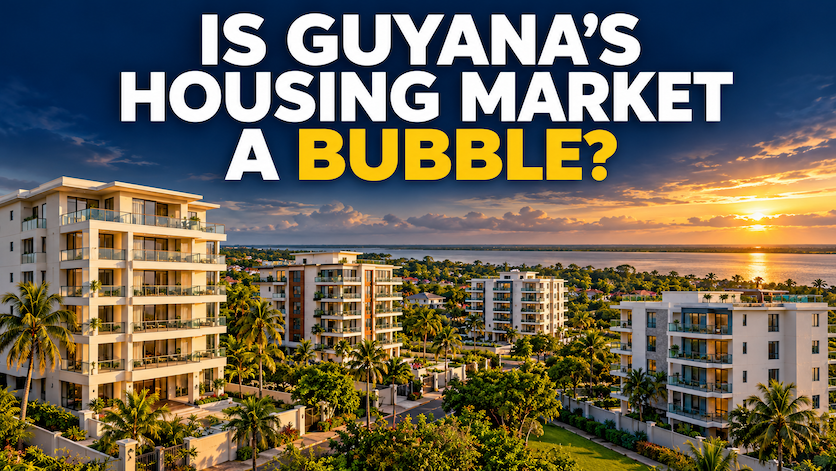
A country has a problem when people begin hoping its property market will collapse so they might finally afford to participate in it. Beneath a recent social media post by influencer Alexander Power, that hope appeared repeatedly. Commenters spoke of waiting for prices to fall, watching for auctions and preparing to purchase properties from owners whose expectations they considered unreasonable. Behind the laughter and emojis was a serious grievance: people looking at Guyana’s property prices could no longer understand who these properties were being priced for.
Power believes the market is a bubble. Whether that prediction proves correct requires evidence beyond a social media discussion. However, the responses to his argument reveal a frustration worth examining. Among those identifying themselves as Guyanese at home and abroad, the recurring complaint was that sellers and landlords appeared to be pricing for a wealthy customer while overlooking the people who actually needed somewhere to live.
Several commenters described advertised monthly rents of US$2,000, US$4,000 and even US$5,000. Others questioned multimillion-dollar asking prices. These are accounts shared by commenters, rather than independently verified transactions, but their central question deserves an answer: which ordinary Guyanese household can sustain these costs? A property owner may imagine an executive with an overseas housing allowance. A teacher, nurse, young entrepreneur or returning pensioner must work with an actual household budget.
The diaspora responses were particularly revealing. People identifying themselves as Guyanese living in Canada and the United States described being shocked by prices back home. Some said they had wanted to purchase property but found asking prices beyond their reach. One questioned why a home in Guyana should cost more than the larger home they already owned overseas. We should pay attention when even the people routinely assumed to have foreign money begin asking who can afford the country.
There is a temptation to treat every complaint about prices as resentment of someone else’s success. That is a convenient way to avoid discussing value. Property owners deserve a reasonable return. Construction, maintenance, financing and reliable services cost money. But an ambitious asking price does not establish that a property delivers equivalent value, and the announcement of another investment project does not automatically increase every prospective tenant’s salary.
Greed enters the picture when the expectation of an exceptional payday replaces a realistic assessment of the customer. Someone hears what another landlord is asking, adds a little more and waits for an oil company to call. Another sees an expensive listing and decides their own property must now be worth a fortune. Repeated often enough, asking prices can become a shared fantasy, with each seller pointing to the next seller as evidence.
One commenter identifying as a real estate professional offered a useful observation: property investment requires the same understanding of markets and customers as any other business. That principle deserves more attention than the excitement surrounding a possible crash. A country can need housing while the available housing remains unaffordable to those who need it. Demand involves the ability to pay. The need for shelter alone cannot meet a landlord’s mortgage.
Yet there was another troubling current in the discussion. Some people eagerly anticipated buying distressed properties cheaply. Others challenged the morality of celebrating losses. Both reactions expose the danger of treating housing principally as an opportunity to extract the largest possible gain. If heavily indebted owners eventually sell to a smaller group of wealthy buyers, ownership could become more concentrated. Lower purchase prices would offer little comfort to ordinary families if affordable homes remained beyond their reach.
A market correction would also have human consequences. Some owners may have borrowed against family assets or committed years of savings to a project. Their judgment can be questioned without celebrating their ruin. The objective should be a functioning property market in which buyers, tenants and owners can make sustainable decisions. Hoping for widespread financial distress is a poor substitute for building that market.
This is why Guyana needs accessible information on actual selling prices, rents being achieved, vacancies and the time properties remain on the market. Asking prices tell us what owners want. Completed transactions tell us what buyers will pay. Without that distinction, an expensive advertisement can be mistaken for evidence of wealth, while an empty building can be presented as evidence of progress.
The comments under Power’s post are a self-selected collection of opinions, including disagreement with his prediction. They cannot establish that Guyana’s entire property market is a bubble. They do, however, capture a powerful sense of exclusion among people who want to live, invest or return home. Their frustration should concern anyone who believes development must improve the lives of Guyanese.
Whether prices fall sharply, soften gradually or remain elevated, the underlying question will persist: where do ordinary citizens fit? A young person who studies, works and saves should have a credible path towards a home. A returning Guyanese should be able to assess a purchase without feeling that their affection for the country has been added to the asking price. When people must wish for a crash before they can imagine owning a piece of their homeland, we should examine what we have begun calling prosperity.