

By Karen Abrams, Ed.D, MBA, AA
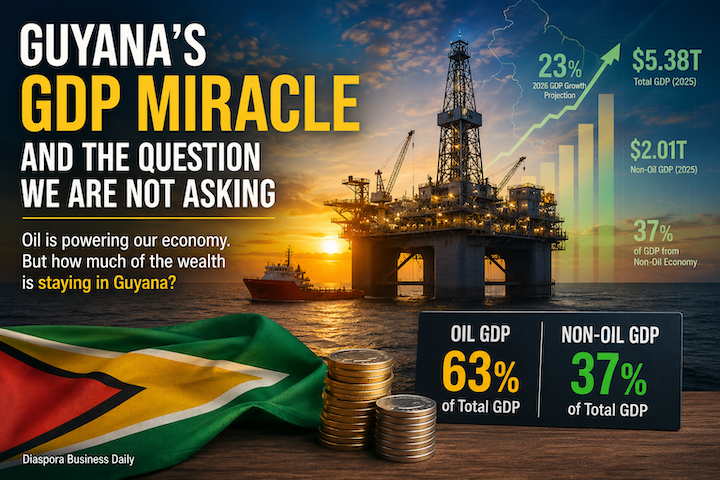
The Inter-American Development Bank’s 2026 Latin American and Caribbean Macroeconomic Report paints an impressive picture of Guyana. The report highlights Guyana’s projected 23 percent economic growth in 2026, praises the country’s fiscal management, and notes that public debt remains relatively low at approximately 30 percent of GDP. The report even identifies Guyana as one of the economies helping to shape global oil markets through increasing petroleum production. These are remarkable achievements for a country that only a decade ago was one of the poorest in South America.
Yet beneath these impressive statistics lies a question that deserves far greater attention.
How much of Guyana’s economic growth actually remains in Guyana?
GDP, or Gross Domestic Product, measures the value of goods and services produced within a country’s borders. It does not measure how much income remains with citizens, businesses, or the government. This distinction matters enormously in an economy dominated by a foreign-owned offshore oil industry.
According to the International Monetary Fund’s 2025 Article IV Consultation, Guyana’s economy is projected to produce approximately GY$5.38 trillion in total GDP in 2025. However, only GY$2.01 trillion of that amount comes from the non-oil economy. The remaining GY$3.37 trillion comes from the petroleum sector. In other words, approximately 63 percent of Guyana’s GDP now originates from oil while only 37 percent comes from the broader domestic economy. The IMF further projects that Guyana’s public debt will remain around 29 to 30 percent of GDP.
These numbers tell a very different story when viewed through another lens.
Using a population estimate of approximately 800,000 people, total GDP per capita is roughly US$32,000. This figure is frequently cited and places Guyana among the wealthiest countries in the region on paper. However, when the petroleum sector is removed, non-oil GDP per capita falls to approximately US$12,000.
The difference is profound.
The headline figure suggests a country approaching developed-world income levels. The non-oil figure describes a country that remains firmly in the developing world. Both numbers are technically correct. The challenge is that only one reflects the productive economy in which most Guyanese live and work.
This is not an argument against oil. Oil has transformed Guyana’s finances and created opportunities that previous generations could scarcely imagine. The IMF reports that Guyana received approximately US$2.47 billion in oil revenues in 2025 and has accumulated nearly US$10 billion in oil revenues since production began. The Natural Resource Fund held approximately US$3.25 billion at the end of 2025. These are extraordinary sums for a nation of fewer than one million people.
Using an 800,000 population estimate, annual oil revenues amount to approximately US$3,090 per citizen, while the Natural Resource Fund represents approximately US$4,060 in savings per citizen. These figures underscore the enormous wealth being generated offshore. They also highlight the responsibility to manage that wealth wisely.
Another issue often overlooked is the use of debt-to-GDP ratios. The IMF and other international institutions correctly report Guyana’s public debt at approximately 30 percent of GDP. By international standards, this appears highly manageable.
However, because oil production accounts for nearly two-thirds of total GDP, the ratio may provide an incomplete picture of the underlying domestic economy. If debt is compared with non-oil GDP instead, the figure rises to more than 80 percent. This does not mean Guyana is over-indebted. Oil revenues are real revenues, and the government receives substantial income from the sector. Nevertheless, the comparison illustrates how dramatically petroleum production alters conventional economic indicators.
The same challenge appears in government finances. Oil revenues now appear to exceed the combined contributions of many traditional tax sources. Historically, governments have depended on citizens and businesses for most of their revenue through income taxes, corporate taxes, value-added taxes, and customs duties. Guyana increasingly derives a substantial share of its revenue from petroleum production. This creates opportunities for investment and development, but it also raises important questions about accountability, diversification, and long-term sustainability.
The most important question facing Guyana today is not whether the country is rich.
The country is unquestionably wealthier than it was a decade ago.
The more important question is whether oil wealth is being converted into lasting productive capacity.
Are Guyanese students receiving a world-class education?
Are local businesses becoming more competitive?
Is agricultural productivity increasing?
Are new industries emerging?
Are workers becoming more productive?
Is non-oil GDP growing because Guyanese enterprises are creating more value?
These are the indicators that will determine whether Guyana becomes a permanently prosperous nation or merely experiences a temporary resource boom.
The future implications are significant. Oil production will not continue expanding indefinitely. Eventually production will plateau and, decades from now, decline. When that day arrives, the strength of Guyana’s economy will depend not on offshore platforms but on the capabilities of its people, institutions, businesses, farms, schools, and technology sectors. Every dollar earned from oil today should therefore be viewed as an opportunity to strengthen the non-oil economy.
The true measure of success will not be how large Guyana’s GDP becomes. It will be whether the country can use oil revenues to build an economy that remains strong long after the oil itself is gone.
That is the statistic we should be watching.